

Knowing what to do after car accident in Texas can protect your health, your legal rights, and your insurance claim all at once. Texas roads see over 500,000 reported crashes each year according to the Texas Department of Transportation (TxDOT). In the moments after a collision, most people feel shaken, confused, and unsure of what comes next.
The steps you take in the first minutes and days after a crash directly affect your ability to recover compensation and avoid legal penalties. This article covers every step in the correct order.
Also Check: What Is Medical Malpractice in Texas, How to Prove It
What to do after car accident in Texas: stop immediately, check for injuries, call 911, move vehicles if safe, exchange information with the other driver, document the scene with photos, report the crash to TxDOT if no police respond, notify your insurer, and see a doctor within 24 hours even with no symptoms.
Texas Car Accident Laws You Need to Know First
Before walking through the steps, understand the Texas laws that apply immediately after a crash.
Texas Transportation Code key rules:
| Law | Requirement |
|---|---|
| Duty to stop (Texas Transportation Code §550.021) | Drivers must stop at the scene of any accident involving injury, death, or property damage |
| Duty to render aid (§550.023) | Drivers must provide reasonable assistance to injured persons |
| Duty to report (§550.026) | Crashes with injury, death, or damage over $1,000 must be reported |
| Leaving the scene with injury or death | Felony offense; up to 10 years in prison |
| Leaving the scene with property damage only | Class C misdemeanor (up to $500 fine) |
| Texas minimum liability insurance | $30,000 per person / $60,000 per accident / $25,000 property damage |
Texas is a fault state for car accidents. The driver who caused the crash is financially responsible for damages. Texas uses a modified comparative fault rule under Civil Practice and Remedies Code Section 33.001, meaning you can recover damages as long as you are not more than 50% at fault. If you are 51% or more at fault, you recover nothing. If you are 30% at fault, your recovery is reduced by 30%.
Step 1: Stop Your Vehicle Immediately
Texas law requires you to stop immediately at or near the scene of any accident. Do not leave. Driving away from an accident involving injury or death is a third-degree felony in Texas, carrying 2 to 10 years in prison and fines up to $10,000.
After stopping:
- Turn on your hazard lights immediately
- Stay calm and take a breath before getting out of the vehicle
- Assess your own physical condition before exiting
- Do not move your vehicle unless it is in a dangerous position (blocking traffic, on a highway with no shoulder)
If the accident is minor and vehicles are operable, Texas law allows and actually encourages drivers to move vehicles to a safe location out of traffic before exchanging information, provided no one is seriously injured.
Step 2: Check for Injuries
Check yourself, your passengers, and anyone in the other vehicle for injuries. Do this before anything else.
Injury assessment steps:
- Ask everyone involved if they are hurt
- Look for visible injuries: bleeding, loss of consciousness, inability to move
- Do not move anyone who complains of neck or back pain unless they face immediate danger (fire, oncoming traffic)
- Call 911 immediately if anyone is injured, unconscious, or trapped
Be aware that adrenaline masks pain. You may feel fine at the scene but develop significant pain hours later. This is why medical evaluation matters even when you feel uninjured.
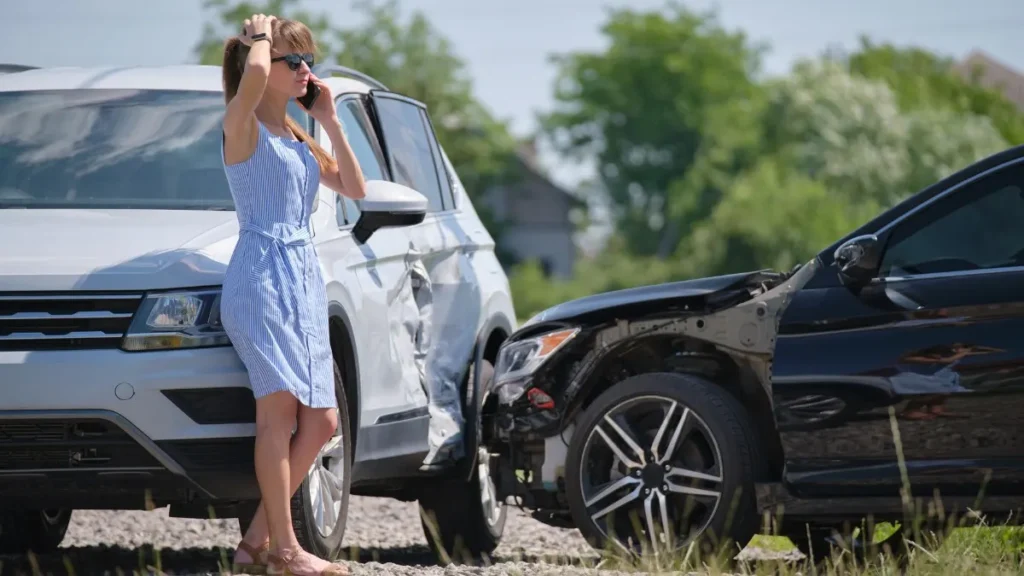
Step 3: Call 911
Call 911 for any accident involving:
- Injury or death
- Significant property damage
- A driver who appears impaired
- A driver who refuses to exchange information
- Blocked traffic creating a hazard
- Uncertainty about the extent of damage or injuries
What to tell the 911 dispatcher:
- Your location (intersection, highway mile marker, or address)
- Number of vehicles involved
- Number of people injured and severity if known
- Any immediate hazards (fuel leak, fire, blocked lanes)
- Your name and callback number
Stay on the line until the dispatcher releases you. Do not hang up first.
When police may not respond:
In many Texas cities, police do not respond to minor accidents with no injuries where both drivers exchanged information and vehicles are drivable. If police do not respond, you must file a crash report yourself with TxDOT (explained in Step 7).
Step 4: Move to Safety
If the vehicles are operable and no one is seriously injured, move vehicles to the shoulder, a nearby parking lot, or a safe area away from moving traffic.
Stopping in a travel lane on a Texas highway is extremely dangerous. TxDOT’s “Steer It and Clear It” campaign encourages drivers to move vehicles out of traffic after minor crashes. Staying in a lane increases the risk of a secondary crash.
After moving to safety:
- Keep hazard lights on
- Set out emergency flares or triangles if you have them and it is safe to do so
- Stay behind a barrier or guardrail if on a highway with no shoulder
- Keep all parties away from moving traffic
Step 5: Exchange Information with the Other Driver
Texas law requires drivers involved in an accident to provide their information to other parties. What to do after car accident in Texas includes collecting and providing specific details.
Information you must exchange:
- Full legal name
- Home address
- Driver’s license number
- Vehicle registration number and license plate
- Name and contact information of vehicle owner (if different from driver)
- Insurance company name and policy number
Additional information to collect:
- Phone number of the other driver
- Make, model, year, and color of the other vehicle
- Names and contact information of all passengers in the other vehicle
- Names and contact information of any witnesses
Do not discuss fault at the scene. Do not apologize. A statement like “I’m so sorry” at the scene can be used as an admission of fault in a later legal proceeding. Stick to factual information exchange only.
Must Read: Employee Rights in Texas Workplace
Step 6: Document the Scene
Scene documentation is one of the most important parts of what to do after car accident in Texas. Photos and notes taken immediately after the crash are far more reliable than memory and become valuable evidence in insurance claims and lawsuits.
Photograph and document the following:
- All vehicles involved from multiple angles (front, rear, sides, close-up of damage)
- The position of vehicles before they are moved (if possible)
- Skid marks, debris, and road conditions
- Traffic signals, stop signs, and road markings near the crash
- Weather and lighting conditions
- Visible injuries on yourself or passengers (with consent)
- The other driver’s license, registration, and insurance card
- License plates of all vehicles involved
- The scene looking in all directions from the point of impact
- Any surveillance cameras visible in the area
If witnesses stop, ask for their names and phone numbers. Write down the responding officer’s name and badge number. Get the police report number before you leave the scene.
Use your phone’s GPS timestamp feature to capture the exact time and location of photos automatically.

Step 7: File a Crash Report with TxDOT
If a Texas peace officer investigates the crash, the officer files the crash report (Form CR-3) with TxDOT. You receive a copy of the report number at the scene.
If no officer responds, Texas Transportation Code Section 550.062 requires the driver to file a crash report if the accident:
- Resulted in injury or death, OR
- Caused apparent damage of $1,000 or more to any vehicle or property
File a Texas Driver’s Crash Report (Form CR-2) online at txdot.gov or by mail within 10 days of the crash.
You can obtain a copy of any filed crash report through TxDOT’s online portal. Insurance companies and attorneys routinely use crash reports when evaluating claims.
Crash report information includes:
- Driver and vehicle information for all parties
- Witness information
- Description of the crash
- Road and weather conditions
- Diagram of the accident
- Officer’s assessment of contributing factors
Step 8: Notify Your Insurance Company
Report the accident to your insurance company promptly, even if you were not at fault. Most Texas insurance policies contain a cooperation clause requiring timely notification of accidents.
When notifying your insurer:
- Report the basic facts: date, time, location, vehicles involved
- Provide the other driver’s insurance information
- Give them the police report number
- Describe your injuries and vehicle damage accurately
- Do not speculate about fault or minimize your injuries
- Ask about your specific coverage: collision, medical payments, uninsured motorist
Texas insurance coverage types:
| Coverage Type | What It Pays For | Required in Texas |
|---|---|---|
| Liability (bodily injury) | Injuries to others when you are at fault | Yes ($30,000/$60,000 minimum) |
| Liability (property damage) | Damage to others’ property when at fault | Yes ($25,000 minimum) |
| Collision | Damage to your own vehicle regardless of fault | No (optional) |
| Comprehensive | Non-collision damage (hail, theft, flood) | No (optional) |
| Medical Payments (MedPay) | Your medical bills regardless of fault | No (optional) |
| Uninsured/Underinsured Motorist | Your damages if other driver has no/insufficient insurance | No (but must be offered) |
| Personal Injury Protection (PIP) | Medical and lost wages regardless of fault | No (but must be offered) |
Texas requires insurers to acknowledge your claim within 15 days, accept or deny it within 15 business days after receiving all information, and pay within 5 business days of accepting the claim.
Step 9: Seek Medical Attention Within 24 Hours
Seeing a doctor within 24 hours of the accident is one of the most important steps in what to do after car accident in Texas, even if you feel fine at the scene.
Why early medical evaluation matters:
- Adrenaline suppresses pain during and immediately after a crash
- Whiplash, soft tissue injuries, and concussions often do not cause symptoms for 24 to 72 hours
- Internal bleeding can be life-threatening and symptom-free initially
- A gap in medical treatment gives insurance companies grounds to argue your injuries were not caused by the accident
- Medical records documenting your injuries and treatment are the foundation of any personal injury claim
Where to seek treatment:
- Emergency room (for severe symptoms, head injury, chest pain, difficulty breathing)
- Urgent care center (for moderate injuries not requiring emergency care)
- Your primary care physician (for follow-up and ongoing treatment)
- A specialist (orthopedic, neurologist, chiropractor) as referred by your physician
Keep all medical records, bills, prescriptions, and documentation of every appointment related to accident injuries.
Step 10: Track All Accident-Related Expenses and Losses
Every expense related to the accident is potentially recoverable in a Texas insurance claim or personal injury lawsuit. Keep organized records from day one.
Track these losses:
- Medical bills (emergency, hospital, specialist, physical therapy, medication)
- Lost wages (days missed from work due to injury or medical appointments)
- Loss of future earning capacity if injuries affect your ability to work long-term
- Vehicle repair or replacement costs
- Rental car expenses during vehicle repair
- Out-of-pocket costs (transportation to appointments, home care, medical equipment)
- Pain and suffering (keep a daily journal documenting pain levels and how injuries affect daily life)
A written pain journal, updated daily, is one of the most persuasive pieces of evidence in a Texas personal injury claim.
Step 11: Understand the Texas Statute of Limitations
Texas Civil Practice and Remedies Code Section 16.003 gives you 2 years from the date of the accident to file a personal injury lawsuit in Texas. This deadline applies to both personal injury and property damage claims.
Exceptions to the 2-year deadline:
| Situation | Modified Deadline |
|---|---|
| Injured party is a minor | 2 years from the minor’s 18th birthday |
| Government vehicle involved | 6-month notice requirement before filing |
| Hit and run (unknown driver) | 2 years from discovery in some circumstances |
| Mental incapacity at time of accident | 2 years from restoration of capacity |
Missing the statute of limitations permanently bars your right to sue, regardless of how strong your case is. Do not wait until the deadline is close to consult an attorney.

Step 12: Consider Consulting a Texas Personal Injury Attorney
What to do after car accident in Texas when injuries are serious or liability is disputed almost always includes consulting an attorney.
When an attorney is worth consulting:
- You suffered injuries requiring medical treatment beyond basic first aid
- You missed work due to injuries
- Fault is disputed or the other driver blames you
- The other driver was uninsured or underinsured
- The insurance company offers a settlement quickly (early low offers are common)
- You are dealing with a commercial vehicle, trucking company, or government entity
- You or a family member suffered permanent injury or disability
Most Texas personal injury attorneys work on a contingency fee basis, meaning no fee unless they recover money for you. Standard contingency fees in Texas range from 33% to 40% of the recovery.
Texas personal injury attorneys handle:
- Communicating with insurance companies on your behalf
- Gathering evidence and accident reconstruction if needed
- Calculating the full value of your damages including future losses
- Negotiating a fair settlement
- Filing a lawsuit and representing you in court if necessary
Step 13: Dealing with the Other Driver’s Insurance Company
If the other driver was at fault, their liability insurance should pay for your damages. Dealing with the at-fault driver’s insurance company requires caution.
Rules for dealing with opposing insurance adjusters:
- You are not required to give a recorded statement to the other driver’s insurer
- Do not accept any settlement offer before completing medical treatment
- Do not sign any release of claims before consulting an attorney
- Get all settlement offers in writing
- Remember that the adjuster works for the insurance company, not for you
Insurance companies have a financial incentive to minimize your claim. An early settlement offer before you know the full extent of your injuries can leave you responsible for future medical bills after you sign the release.
Frequently Asked Questions
Do I have to call the police after a car accident in Texas?
Texas law requires you to report accidents involving injury, death, or property damage over $1,000. If police do not respond to a minor accident, you must file a Texas Driver’s Crash Report (Form CR-2) with TxDOT within 10 days. Always call 911 if anyone is injured or you are unsure of damage severity.
How long do I have to report a car accident to my insurance in Texas?
Texas law has no set deadline for notifying your insurer, but your policy likely requires prompt notification. Report the accident as soon as possible, ideally within 24 hours. Delaying notification gives insurers grounds to argue the delay prejudiced their ability to investigate and can complicate your claim.
What if the other driver has no insurance in Texas?
About 20% of Texas drivers carry no insurance. If an uninsured driver hits you, file a claim under your own uninsured motorist (UM) coverage if you have it. You can also sue the at-fault driver personally, though collecting a judgment from someone with no assets is often difficult. UM coverage is the most reliable protection.
Can I be compensated if I was partly at fault for the accident in Texas?
Yes, as long as you are 50% or less at fault. Texas uses modified comparative fault. If you are 30% at fault and your damages total $100,000, you recover $70,000. If you are found 51% or more at fault, you recover nothing. Insurance adjusters and juries determine fault percentages based on evidence.
How long does a Texas car accident insurance claim take to resolve?
Simple claims with clear liability and minor injuries can resolve in 4 to 8 weeks. Claims involving significant injuries, disputed fault, or uninsured drivers take 6 months to 2 years. Texas law requires insurers to acknowledge claims within 15 days and pay accepted claims within 5 business days of acceptance, but complex claims take longer to investigate.
Should I accept the first settlement offer from the insurance company?
Rarely. First settlement offers in Texas car accident claims are typically below the full value of your damages, especially if you have not completed medical treatment. Once you accept a settlement and sign a release, you cannot go back for more money even if your injuries worsen. Consult an attorney before accepting any settlement offer for a serious injury claim.
Conclusion
Knowing what to do after car accident in Texas protects your health, your legal rights, and your financial recovery at every stage. Stop immediately, document everything at the scene, get medical attention within 24 hours, report the crash through the proper channels, and track every expense from day one.
What to do after car accident in Texas when injuries are serious includes consulting a personal injury attorney before speaking with insurance adjusters or signing any documents, because the decisions you make in the days after a crash shape the outcome of your entire claim.

Leave a Comment